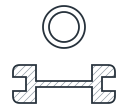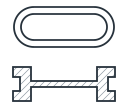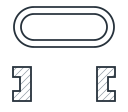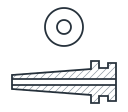
An open rubber grommet protects a cable or tube where it passes through a panel. Rubber bellows are a different type of component; the names should not be treated as interchangeable.
Select the correct dimensions
The bore diameter describes the opening through the grommet. The mounting-hole specification describes the panel cutout. On a conventional grooved profile, the flange outside diameter is larger than the mounting hole so that it overlaps the edge.
Check the specified panel-thickness range, groove width and overall thickness. Include enough clearance for the cable and any connector involved in assembly.
Match the function and material
An open bore does not automatically seal around a cable. If sealing is required, specify a suitable profile and verify the assembly. Select the compound for temperature, fluid and mechanical conditions; color is not a substitute for a material specification.
Read the dimensions by function
The bore describes the passage through the part, while the specified mounting hole describes the panel cutout. The outside flange overlaps the panel edge on a conventional grooved profile. Compare each dimension with the corresponding feature in the assembly instead of using one diameter as a substitute for all three.
Check the axial dimensions too
Match groove width and the specified panel-thickness range, and check overall thickness and flange clearance. Include any connector that must pass through the part during installation. Review the complete drawing before comparing two parts with similar bore sizes.