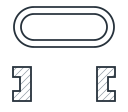
A silicone grommet intended for food-contact equipment needs requirements specific to the compound, finished part and conditions of use. A clear appearance, a silicone material label or a general product description does not establish that a part is suitable for every food-contact application.
Define the contact and cleaning conditions
Identify what the part will contact, the contact duration and temperature, whether use is repeated, and the cleaning or sanitizing conditions. Specify the applicable requirements for the intended equipment and market. Confirm that the proposed compound and finished part meet those requirements before approval.
Do not assume that a grommet is sterile, prevents microbial growth or is suitable for every kitchen application. The complete assembly and its cleaning process need to be assessed for the intended use.
Check the mechanical function
Provide the opening dimensions, panel thickness, required passage and installation method. State whether the part provides edge protection, supports a tube or forms part of a sealing interface. Any retention or sealing performance requires defined acceptance criteria and evaluation in the actual assembly.
Compare profiles in the silicone grommet selection guide. Confirm the material grade and configuration for the selected part, including hardness, color and service conditions.
Agree on the production specification
For a standard part, confirm availability, minimum quantity and the agreed requirements before ordering. For custom manufacture, provide a drawing or existing sample for manufacturability review, quotation, tooling and sampling. Record the approved part specification and acceptance criteria before production.