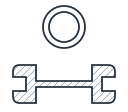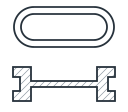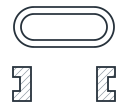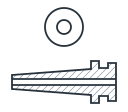
Large rubber grommets can provide a protective interface around cable bundles, hoses or other components passing through a panel. Their suitability depends on the complete profile, material and installation, rather than size alone.
Measure the opening and the route through it
Measure the panel cutout and thickness, the cable bundle or hose diameter, and the largest connector that must pass through during assembly. Allow space for the outer flange and for installation access. For an oval opening, check both axes against the drawing.
The large grommet size tables group parts by inside diameter. Compare every relevant dimension with the intended assembly, including groove diameter, groove width and overall thickness. A large bore does not by itself establish that a grommet fits the panel.
Select the material for the environment
Define temperature, sunlight and weather exposure, contact fluids, movement and any required sealing or electrical performance. Rubber families have different strengths and limitations; weathering resistance or service life cannot be assumed for every compound.
Use the material comparison guide to narrow the options, then confirm the compound for the selected part. Temperature limits depend on the grade and exposure conditions. Avoid treating a published silicone temperature range as a rating for natural rubber, neoprene or another material.
Verify installation and order requirements
Check the sample in the intended assembly and agree on the acceptance criteria. Confirm the available configuration, price and minimum quantity for a standard part. If no listed profile fits, provide a drawing or existing sample for manufacturing review and quotation.