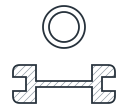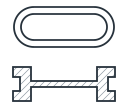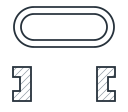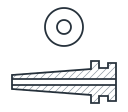
A molded rubber part can change dimensions as it cures, cools and undergoes any specified post-cure or conditioning. Tooling allowances must account for this behavior so that the finished part meets its drawing tolerances.
Calculating dimensional shrinkage
Using the mold dimension as the reference, shrinkage (%) = (mold dimension − finished-part dimension) / mold dimension × 100. For example, a 150 mm reference dimension and a 147 mm finished dimension give 2% shrinkage. This is an arithmetic example, not a recommended allowance for every compound.
Factors to control
The compound, filler content, cure cycle, part geometry and measurement conditions can influence the result. A published percentage for one formulation should not be transferred to another without verification.
Measure representative samples after the specified conditioning period and record the measurement method. Use the resulting data to review tooling allowances and check every critical dimension, rather than applying an unsupported universal shrinkage range.